
Books
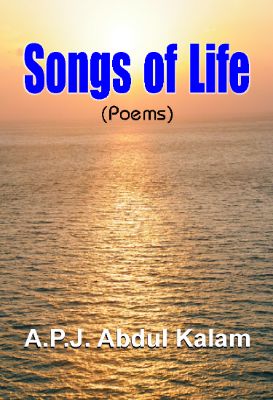
Songs of Life by A P J Abdul Kalam
The Songs of Life is presented with selected poems from my books of poem Life Tree, Luminous Sparks and My Journey, and also some of my new poems. The purpose of this Songs of Life is to celebrate the human life. Inspite of many sufferings all around, God has blessed us with his grace in multiple dimensions of nature smiling at us. Hence, Songs of Life is the Song of every heart and soul in happiness and, in sorrow. The result of the poems should be to cheer our hearts.
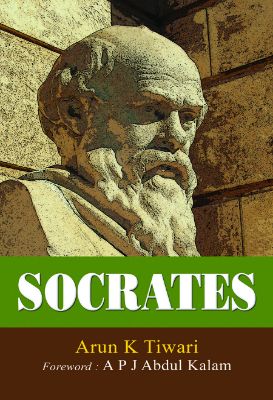
Socrates by Arun K Tiwari
Socrates had an early interest in the scientific theories of Anaxagoras, who taught that there are an infinite number of different kinds of elementary particles (atoms) and it is the action of Mind upon these that produces the objects that we see. Socrates believed that the senses of the body created difficulty for the thinking of the mind and came to regard the physical world as deceptive.
He believed that his work, which he sought to understand through critical questioning and dialogue, was given to him as a divine mission and, hence, was his duty. His total lack of interest in material possessions was evident by his always being barefoot and wearing an old cloak the whole year round. His habit of going barefoot even in winter showed his powers of endurance too. To him, the aspiration for virtue was the highest aim anyone could have.
Socrates’ philosophy was a matter of how to live one’s life. In subsequent centuries the love of wisdom became a great deal more academic, something that could be as remote from people’s practical concerns as a game of chess. “There are nowadays professors of philosophy, but not philosophers”, Thoreau writes in Walden. And he adds, “To be a philosopher is to love wisdom as to live according to its dictates, it is to solve some of the problems of life, not only theoretically, but practically.”
(from Dr. A.P.J. Abdul Kalam’s Foreword)

Be Your Own Pilot by Sqn. Ldr. Manish Kumar (Retd.)
In this inspirational fiction, Manish Kumar talks about the unlimited power and potential lying dormant in every soul, waiting to be awakened. The moment we become aware of the power within, we stop being a victim of circumstances, get off the autopilot called fate and take control of our life.
‘Be your own Pilot’ is about the journey of a boy from a small town who realizes his dream of becoming a pilot, learns the lessons of life on the way and goes on to inspire others to follow their dreams. His Flying Instructor implants wisdom into the flying lessons and teaches him to take the flight of faith. The book shows the way – how, by aligning personal desires to the benefit for mankind, it is possible to lead a deeply rich and satisfying life.
Using flying as a metaphor, Manish Kumar has penned this extremely enjoyable story. Peppered with the author’s insights, this books is sure to touch and inspire you to break the shackles of self-limiting beliefs and to take off in life.

Khudiram Bose by S.K. Agrawal
Khudiram Bose was born on December 3,1889 in Bahubeni village of Midnapur district in Bengal (now West Bengal). His father was Trailokyanath Bose and his mother Lakshmipriya Devi. His father was a Tehsildar in the service of the Raja of Nadhol. His mother was a pious lady. Being the only child of his parents, he was brought up with extreme love and affection. Though he was dark complexioned, he was good looking. Whosoever saw him, loved him.

Khan Abdul Ghaffar Khan by Meena Manishika
Khan Abdul Ghaffar Khan was affectionately known as ‘Badshah Khan’ . He had awakened people in Frontier and Baluchistan in undivided India for freedom. He played the same role in Frontier Province, which Mahatma Gandhi had played in the rest of India. Therefore, he is also known as ‘Frontier Gandhi’. He was completely devoted to the non-violent movement of Gandhiji and had great faith in it. He dedicated his entire life the service of the people of Frontier Province and set an example of communal harmony in the freedom struggle.

Kalpana Chawla by Sunita Rani
If you want to attain something then remain focussed’ were the words of none other than Kalpana Chawla. This also sums up her life. She remained focused and reached where others fear to tread. Kalpana Chawla belonged to a middle class family in Haryana. She was born to Banarasi Lal Chawla and Sanjyothi on July 1, 1961 at Karnal, in Punjab, now in Haryana. Kalpana had two sisters and a brother who were elder to her. She was the youngest; therefore, everyone affectionately called her ‘Montu’.

Jotiba Phule by Mayaram
Jotiba Phule was a renowned Maharashtrian reformer of his time. He was born in 1827, in a mali family in Satara district of Maharashtra. The mali caste was considered a low caste by society . His full name was Jotirao Govindrao Phule. His father ’ s name was Govindrao Phule. He was a vegetable vendor in Pune. The family known as Gorhays, was originally from Katgun, a village in the Satara district. His grandfather ’ s name was Shetiba Gorhay . He came to Pune and settled there. Their family was named Phule or flowers, because his uncles and his father were florists under the last of Peshwas. His mother passed away when he was just nine months old.

Jaiprakash Narayan by Kapil
Jaiprakash Narayan was born on October 11, 1902, in a village named Sitabadiyara in district Baliya, situated on the border between Bihar and Uttar Pradesh. His father’s name was Shri Harsu Dayal and his mother’s name was Shrimati Phoolrani Devi. His father was a jiledar in the canal (irrigation) depar tment in Arra city of Bihar.

Jagdish Chandra Bose by Sanjay Goyal
The world famous Indian scientist, Jagdish Chandra Bose, was born on 30th November, 1858 at a small town called Mymensingh in East Bengal (now Bangladesh). His father , Sri Bhagwan Chandra Bose was a deputy magistrate. Jagdish was the only son. He was brought up with love and care. Those days, his family was considered as belonging to the high class society.

Ishwar Chandra Vidyasagar by Manish Kumar
Ishwar Chandra Vidyasagar holds an honourable position amongst the founding fathers of modern India. He is known as a writer , social reformer and great educationist. He understood well the importance of education and made grammatical rules of the Bengali language. Throughout his life, he struggled hard to get women’ s education and widow marriage as a social recognition. This was a revolutionary step in Indian society .

Indira Gandhi by Manish
Indira Gandhi was not only the first woman Prime Minister of India, but also amongst the ten greatest women of the world. She remained the Prime Minister of India from 1966 to 1977 and from 1980 to 1984. During her time, she was as popular as Queen Elizabeth I. Shrimati Indira Gandhi was born on November 19, 1917 in Allahabad. She was the only child of India’ s first Prime Minister Jawaharlal Nehru and Kamla Nehru. Being the only child, she was highly adored by her grandfather, Pandit Motilal Nehru.

Homi Jahangir Bhabha by Sanjay Goyal
The beginning of the nuclear science programmes in independent India marked the rise of a new powerful India. The credit for this goes to Dr . Homi Jehangir Bhabha, who laid the foundation of these programmes. It is for this reason that he is known as “the Director of the Nuclear Science in modern India” . Dr . Homi Jehangir was born on 30 October , 1909 in Bombay in an educated and prosperous Parsi family . His grandfather , Dr . Hurmus Bhabha was the Director of the Department of Education in the State of Mysore and his father Shri J.H. Bhabha got his education for some time in the Oxford University . His name is taken with respect in the then senior barristers. Her mother’s name was Smt. Mehran Bhabha. She was a very simple and religious lady.

Hargobind Khorana by Nandini
Har Gobind Khorana, the Nobel Prize winner for Medicine in 1968, shared the prize with M.W . Nuremberg and R.W . Holley for interpreting the genetic code and analyzing its function in protein synthesis. Khorana is known as a scientist who revolutionized biochemistry with his pioneering work in DNA chemistry . A legend in the history of Genetics he was a marvellous scientist. He was the first person of Indian origin since Independence to receive the Nobel Prize. Khorana was a scientist par excellence.

Guru Nanakdev by Sanjay Goyal
Guru Nanakdev , the saint among saints, was the founder of the Sikh religion and the first Guru of the Sikhs. He won the faith and love of people as he travelled for about 46 years from place to place, spreading his godly message amongst the people. He had great compassion for the poor and the helpless. Guru Nanakdev was born on April 15, 1469, in Talwandi, a village near Lahore. This place, known as ‘Nankana Saheb’, is now in Pakistan. His father was Kalu Mehta and mother was Tripta Devi. His mother was a highly religious lady . Nanakji had an elder sister, known as Nanki.
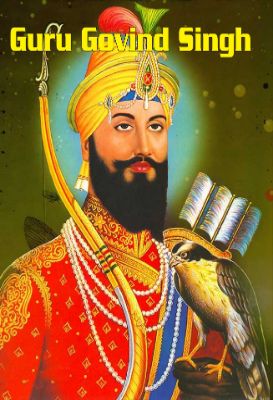
Guru Govind Singh by Sumit Kumar
Guru Gobind Singh was the tenth and last Guru of the Sikh religion. Afterwards, the Guru tradition came to an end in Sikhism. He was a great military general, brave revolutionary, freedom-loving nationalist and social reformer . He produced amongst the Sikhs the leadership quality of Sardar . He even instructed his followers to use the surname of Singh meaning ‘lion ’. He made the panch kakara (the five objects) compulsory for the Sikhs. These are Kesha (hair), Kangha (comb), Kara (iron bangle), Kripan (dagger) and Kachchha (underwear).
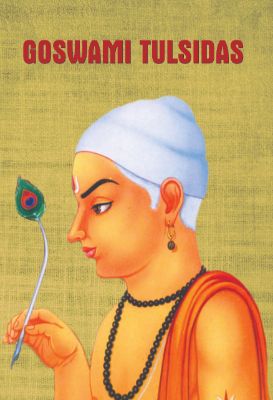
Goswami Tulsidas by Meena Manishika
Once Surdas, the devotee of Lord Krishna, was asked, “Whose poetr y is the best?” Surdas said, “Mine.” The questioner asked again, “What about T ulsi’s poetry?” Surdas replied, “T ulsi’s poetr y is extraordinary . It contains the sacred verses from the scriptures”. No doubt, T ulsidas was a great poet and divine saint. He had made a serious study of the Vedas, the Puranas etc. He was devoted to the service of the society . He had all the qualities of a great poet. T ulsi is also considered as a humanitarian poet. He made a successful attempt through his works to present the developed form of humanity before people at large. Therefore, Dr . Grearson remarked that he is the most remarkable poet in Asia.
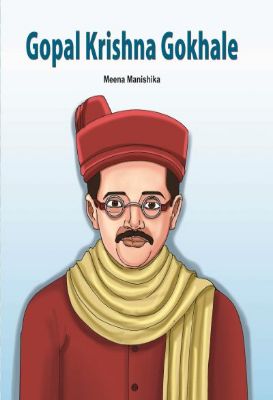
Gopal Krishna Gokhale by Meena Manishika
Mahatma Gandhi is known as the ‘Father of the Nation’ and an ‘ apostle of non-violence’ . He influenced the life of millions within the nation and outside. But very few know , who influenced Mahatma Gandhi. The person who had influenced him was Gopal Krishna Gokhale. Mahatma Gandhi considered Gokhale as his Guru and the source of inspiration.
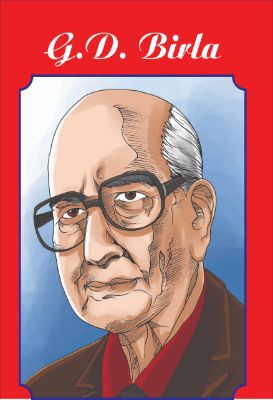
Ghanshyam Das Birla by Durga Prasad
Ghanshyam Das Birlaor G.D . Birla, as he was generally called, belonged to the Marwari business family of the Birlas . In fact, he was one of the pillars that set up the Birla business. He is one of the greatest Indians of the twentieth centur y . He was born on April 10, 1894 and died on June 11, 1983.
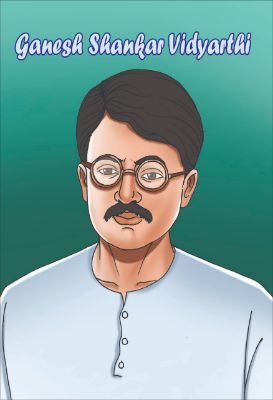
Ganesh Shankar Vidyarathi by Manish
Ganesh Shankar Vidyar thi was not only a fearless and unbiased jour nalist, but also a social worker , freedom fighter and an able statesman. He made a significant contribution to the freedom struggle of India. Ganesh Shankar was born on October 26, 1890, at Atarsuiya in Allahabad at his mater nal grandfather’s home. His father, Shri Jai Narain, was a resident of Fatehpur (Uttar Pradesh.) At that time , he was working as the principal of Anglo V ernacular School at Mungawali in Madhya Pradesh province. His mother Gomti Devi was a pious lady.
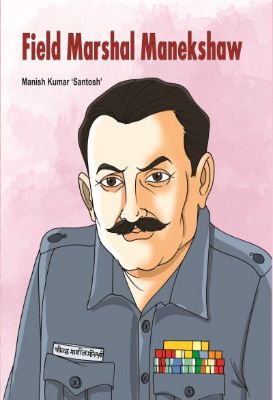
Field Marshal Manekshaw by Manish Kumar ‘Santosh’
The full name of Field Marshal Manekshaw is Sam Hormushji Framji Jamshedji Manekshaw. He was born on April 3, 1914 at Amritsar in a Parsi family. His father H.F. Manekshaw was a doctor. Once, when his father was going from Bombay to Lahore in search of employment, due to change in decision, he had to get down at Amritsar in Punjab. As a result he settled down in Punjab. He had four sons and two daughters. Sam was their fifth child.
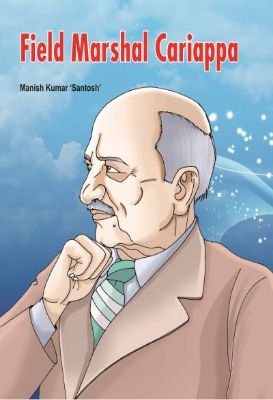
Field Marshal Cariappa by Manish Kumar ‘Santosh’
The full name of Cariappa was Kodandera Madappa Cariappa. He was the pride of Indian army . He was born on January 28, 1899, at a place called Shanivavsante, in eastern part of Coorg in Karnataka. The place is now known as Kodagn. Cariappa’ s father Kodandera was a revenue officer in Madikeri. He used to stay with his family at Lime Cottage. Cariappa had three brothers and two sisters. Everyone at Cariappa’ s home addressed him affectionately as ‘Chimma’.
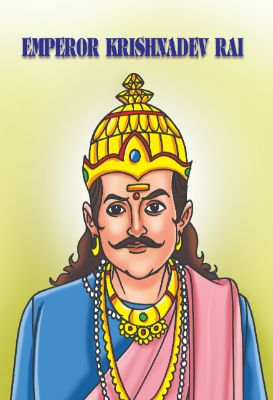
Emperor Krishnadev Ray by Manish Kumar
Krishnadev Rai was one of the most magnificent, brave, kind and chivalrous kings of the Vijayanagar Empire. He patronised different religions and cultural arts lavishly during his rule. He was a writer and connoisseur of literature as well. He had constructed hundreds of splendid temples in his kingdom. Moreover, for the public welfare, he got thousands of ponds and canals dug for the development of agriculture. Thus, the people in his kingdom were very happy and prosperous.

Bharata by Anil Kumar ‘Salil’
There is no reference about the time of birth of Bharata, the son of Dushyanta either in the history or in the Puranas. We could find a brief reference in the Mahabharata only . On its basis, the writers have portrayed his character in their poetic imagery . The story of the birth of Bharata is quite interesting.
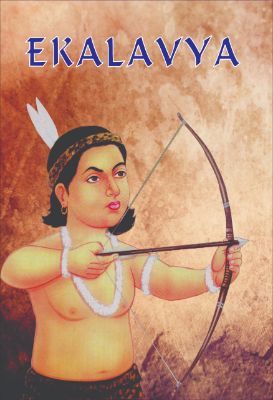
Ekalavya by Manish Kumar
Ekalavya was a little known character of the Mahabharata. No clear reference is available anywhere as to when and where he was born. In the Mahabharata, Ekalavya was referred for the first time, as a keen boy who wanted to learn archer y from the lear ned Guru Dronachar ya. According to the Mahabharata, Ekalavya was the son of a Bhil (a tribe) chief, Hiranyadhanu. Hiranyadhanu lived in a forest a little distance away from Hastinapur. He was the chief of his tribe. Ekalavya was brought up in the same forest.
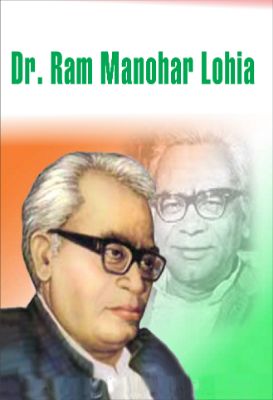
Dr. Ram Manohar Lohia by Kapil
Dr. Ram Manohar Lohia, the great freedom fighter, extraordinary , thinker and a revolutionary of the movement for equality was born , on March 23, 1 9 1 0, in the town of Akbarpur near Ayodhya, the birth place , of Lord Rama. T oday this place is a district headquarter named Ambedkar , Nagar . The name of his father was Hiralal and his mother was Chanda , Devi.,
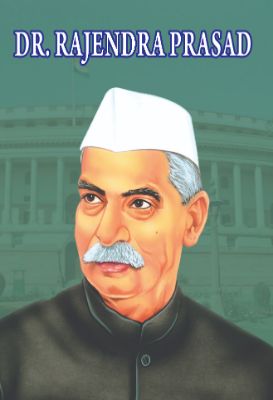
Dr. Rajendra Prasad by Kavita Garg
India’ s first President, Dr . Rajendra Prasad was born on 3rd December, 1884, in a small village called J eeradei in Chhapra district. His father, Shri Mahadev Sahay was proficient in P ersian. He was also proficient in medicine . Through this, he serv ed the people a lot.
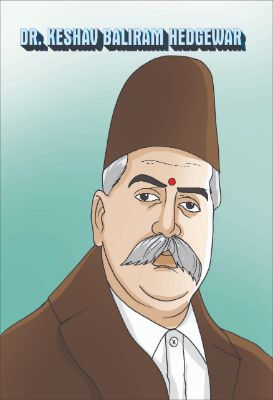
Dr. Keshav Baliram Hedgewar by Sumit Kumar
The Hedgewar family lived on the confluence of Rivers Godavari, Haridra and V anjara, where a village, Kandkur ti, was situated in Andhra Pradesh. Later , one of their descendants shifted to Nagpur . T o this lineage belonged a dedicated, dutiful and philanthropist Balirampant Hedgewar . The name of his wife was Rewati Sushila. They had six children—three sons and three daughters. The eldest amongst the sons was Mahadev , the middle one was Sitaram and the youngest was Keshav . Amongst them, Keshav (K eshav Baliram Hedgewar), la ter on, went up to earn name and fame for himself in India and across the world.
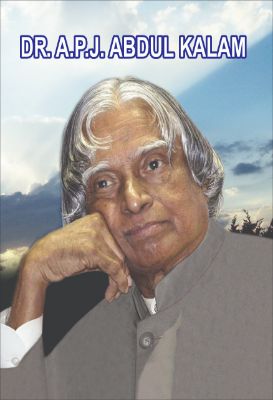
Dr. A.P.J. Abdul Kalam by Sachin Sinhal
Regarded as an ideal Indian and a source of inspiration for the future generations, President Dr. A.P.J. Abdul Kalam was born on October 15, 1931 in an ordinary Tamil family of Rameshwaram in Tamil Nadu. His full name is Abul Pakir Jainulabedin Abdul Kalam. His father Jainulabedin and mother Aashiamma were a simple and religious-minded couple. They held an honourable place in the society and were regarded as an ideal couple. They lived in a joint family.
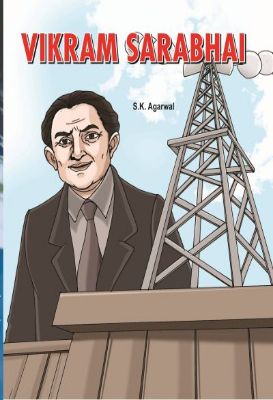
Dr. Vikram Ambalal Sarabhai by S.K. Agrawal
Dr . Vikram Ambalal Sarabhai, the father of Indian space research programme, was amongst the greatest Indian scientists. The credit f or India’ s crucial position and success in the field of space research goes to him. He inspired the Indian scientists not only to participate in research but also to work towards social development.
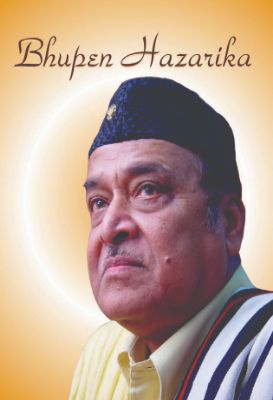
Bhupen Hazarika by Sumit Kumar
The moment one reads these lines, the sonorous voice of Bhupen Hazarika rings in your ears. The singer who could hold sway over listeners with his soothing melodies needs no introduction.