
Books
Applied Discrete Structures
In writing this book, care was taken to use language and examples that gradually wean students from a simpleminded mechanical approach and move them toward mathematical maturity. We also recognize that many students who hesitate to ask for help from an instructor need a readable text, and we have tried to anticipate the questions that go unasked.The wide range of examples in the text are meant to augment the “favorite examples” that most instructors have for teaching the topics in discrete mathematics.To provide diagnostic help and encouragement, we have included solutions and/or hints to the odd-numbered exercises. These solutions include detailed answers whenever warranted and complete proofs, not just terse outlines of proofs.Our use of standard terminology and notation makes Applied Discrete Structures for Computer Science a valuable reference book for future courses. Although many advanced books have a short review of elementary topics, they cannot be complete.The text is divided into lecture-length sections, facilitating the organization of an instructor’s presentation. Topics are presented in such a way that students’ understanding can be monitored through thought-provoking exercises. The exercises require an understanding of the topics and how they are interrelated, not just a familiarity with the key words.An Instructor’s Guide is available to any instructor who uses the text. It includes:Chapter-by-chapter comments on subtopics that emphasize the pitfalls to avoid;Suggested coverage times;Detailed solutions to most even-numbered exercises;Sample quizzes, exams, and final exams.Subscribe to the Applied Discrete Structures Blog to keep up to date on the progress of this project.This textbook has been used in classes at: Casper College (WY), Grinnell College (IA), Luzurne Community College (PA), University of the Puget Sound (WA)
APEX Calculus: Version 2.0
This text comprises a three–text series on Calculus. The first part covers material taught in many “Calc 1” courses: limits, derivatives and the basics of integration, found in Chapters 1 through 6.1. The second text covers material often taught in “Calc 2:” integration and its applications, along with an introduction to sequences, series and Taylor Polynomials, found in Chapters 5 through 8. The third text covers topics common in “Calc 3” or “multivariable calc:” parametric equations, polar coordinates, vector–valued functions, and functions of more than one variable, found in Chapters 9 through 13.
The AP Physics Collection
The AP Physics Collection is a free, turnkey solution for your AP® Physics course, brought to you through a collaboration between OpenStax and Rice Online Learning. The integrated collection features the OpenStax College Physics for AP® Courses text, Concept Trailer videos, instructional videos, problem solution videos, and a correlation guide to help you align all of your free content.The College Physics for AP® Courses text is designed to engage students in their exploration of physics and help them apply these concepts to the Advanced Placement® test. This book is Learning List-approved for AP® Physics courses.
Antiracist Writing Assessment Ecologies: Teaching and Assessing Writing for a Socially Just Future, Perspectives on Writing
In Antiracist Writing Assessment Ecologies, Asao B. Inoue theorizes classroom writing assessment as a complex system that is “more than” its interconnected elements. To explain how and why antiracist work in the writing classroom is vital to literacy learning, Inoue incorporates ideas about the white racial habits that informs dominant discourses in the academy and other contexts. Inoue helps teachers understand the unintended racism that often occurs when teachers do not have explicit antiracist agendas in their assessments. Drawing on his own teaching and classroom inquiry, Inoue offers a heuristic for developing and critiquing writing assessment ecologies that explores seven elements of any writing assessment ecology: power, parts, purposes, people, processes, products and places.
Anatomy and Physiology
Published by OpenStax College, Anatomy and Physiology is a dynamic textbook for the yearlong Human Anatomy and Physiology course taught at most two- and four-year colleges and universities to students majoring in nursing and allied health. Anatomy and Physiology is 29 chapters of pedagogically effective learning content, organized by body system and written at an audience-appropriate level. The lucid text, strategically constructed art, inspiring career features and links to external learning tools address the critical teaching and learning challenges in the course.
Reconciliation, Civil Society, and the Politics of Memory: Transnational Initiatives in the 20th and 21st Century
How did civil society function as a locus for reconciliation initiatives since the beginning of the 20th century? The essays in this volume challenge the conventional understanding of reconciliation as a benign state-driven process. They explore how a range of civil society actors – from Turkish intellectuals apologizing for the Armenian Genocide to religious organizations working towards the improvement of Franco-German relations – have confronted and coped with the past. These studies offer a critical perspective on local and transnational reconciliation acts by questioning the extent to which speech became an alternative to silence, remembrance to forgetting, engagement to oblivion.
Analysis of Structural Member Systems
This course uses computer-based methods for the analysis of large-scale structural systems. Topics covered include: modeling strategies for complex structures; application to tall buildings, cable-stayed bridges, and tension structures; introduction to the theory of active structural control; design of classical feedback control systems for civil structures; and simulation studies using customized computer software.
American Government and Politics in the Information Age
Our text is a comprehensive introduction to the vital subject of American government and politics. Governments decide who gets what, when, how (See Harold D. Lasswell, Politics: Who Gets What, When, How, [New York: McGraw-Hill, 1936]); they make policies and pass laws that are binding on all a society’s members; they decide about taxation and spending, benefits and costs, even life and death.Governments possess power—the ability to gain compliance and to get people under their jurisdiction to obey them—and they may exercise their power by using the police and military to enforce their decisions. However, power need not involve the exercise of force or compulsion; people often obey because they think it is in their interest to do so, they have no reason to disobey or they fear punishment. Above all, people obey their government because it has authority; its power is seen by people as rightfully held, as legitimate. People can grant their government legitimacy because they have been socialized to do so; because there are processes, such as elections, that enable them to choose and change their rulers; and because they believe that their governing institutions operate justly.Politics is the process by which leaders are selected and policy decisions are made and executed. It involves people and groups, both inside and outside of government, engaged in deliberation and debate, disagreement and conflict, cooperation and consensus and power struggles.In covering American government and politics, our text introduces the intricacies of the Constitution, the complexities of federalism, the meanings of civil liberties and the conflicts over civil rights; explains how people are socialized to politics, acquire and express opinions and participate in political life; describes interest groups, political parties and elections—the intermediaries that link people to government and politics; details the branches of government and how they operate; and shows how policies are made and affect people’s lives. This textbook has been used in classes at: Metropolitan College of New York, University of Central Oklahoma, Bucks County Community College, University of South Carolina — Beaufort, Delaware County Community College, Collin College — Spring Creek, Austin Community College — Northridge, Randolph College, Columbia Gorge Community College, Central Christian College, Thomas More College, Orange Coast College, San Bernardina Valley College, Southwestern College — Chula Vista, De Anza College, Shasta College, Jacksonville University, Northeastern University, University of Baltimore, Southern New Hampshire University, Seattle Central Community College, Edmonds Community College, Minneapolis Community and Technical College, Brazosport College, Sul Ross State University, Odessa College, California State University — Monterey Bay, University of Texas — Arlington, Chabot College, Portland Community College — Cascade, Athens High School, Dalat International School, Paradise Education Center, St. Teresa’s Academy, South Broward High School, Academy of the Sacred Heart, St. Ignatius College Preparatory, Henrico County Public Schools, Blue Ridge High School, Newell High School, Southern New Hampshire University, American University in Bulgaria, Miami Springs Senior High School, Seattle Central Community College, Milaca High School, Rock Canyan High School, Media Arts Collaborative Charter School, Susan E. Wagner High School, St. Monica’s University, Chaminade-Madonna College Preparatory.
American Government 3e
American Government 3e aligns with the topics and objectives of many government courses. Faculty involved in the project have endeavored to make government workings, issues, debates, and impacts meaningful and memorable to students while maintaining the conceptual coverage and rigor inherent in the subject. With this objective in mind, the content of this textbook has been developed and arranged to provide a logical progression from the fundamental principles of institutional design at the founding, to avenues of political participation, to thorough coverage of the political structures that constitute American government. The book builds upon what students have already learned and emphasizes connections between topics as well as between theory and applications. The goal of each section is to enable students not just to recognize concepts, but to work with them in ways that will be useful in later courses, future careers, and as engaged citizens.
In order to help students understand the ways that government, society, and individuals interconnect, the revision includes more examples and details regarding the lived experiences of diverse groups and communities within the United States. The authors and reviewers sought to strike a balance between confronting the negative and harmful elements of American government, history, and current events, while demonstrating progress in overcoming them. In doing so, the approach seeks to provide instructors with ample opportunities to open discussions, extend and update concepts, and drive deeper engagement.
American Government 2e
American Government 2e is designed to meet the scope and sequence requirements of the single-semester American Government course. This title includes innovative features designed to enhance student learning, including Insider Perspective features and a Get Connected module that shows students how they can get engaged in the political process. The book provides an important opportunity for students to learn the core concepts of American Government and understand how those concepts apply to their lives and the world around them.
Changes made in American Government 2e are described in the preface to help instructors transition to the second edition. The first edition of American Government by OpenStax is available in web view here.
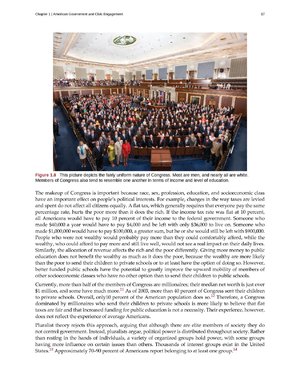
American Government
American Government is designed to meet the scope and sequence requirements of the single-semester American Government course. This title includes innovative features designed to enhance student learning, including Insider Perspective features and a Get Connected module that shows students how they can get engaged in the political process. The book provides an important opportunity for students to learn the core concepts of American Government and understand how those concepts apply to their lives and the world around them.Senior Contributing Authors: Glen Krutz, University of OklahomaSylvie Waskiewicz, Ph.D. Contributing Authors: Joel Webb, Tulane UniversityShawn Williams, Campbellsville UniversityRhonda Wrzenski, Indiana University SoutheastTonya Neaves, George Mason UniversityAdam Newmark, Appalachian State UniversityBrooks D. Simpson, Arizona State UniversityProsper Bernard, Jr., City University of New YorkJennifer Danley-Scott, Texas Woman’s UniversityAnn Kordas, Johnson and Wales UniversityChristopher Lawrence, Middle Georgia State College
Algorithms and Data Structures: With Applications to Graphics and Geometry
This is a textbook for first year Computer Science.
Algebraic Curves: An Introduction to Algebraic Geometry
The aim of these notes is to develop the theory of algebraic curves from the viewpoint of modern algebraic geometry, but without excessive prerequisites. We have assumed that the reader is familiar with some basic properties of rings, ideals and polynomials, such as is often covered in a one-semester course in modern algebra; additional commutative algebra is developed in later sections.
Algebra and Trigonometry
Published by OpenStax College, Algebra and Trigonometry provides a comprehensive and multi-layered exploration of algebraic principles. The text is suitable for a typical introductory Algebra and Trigonometry course, and was developed to be used flexibly. The modular approach and the richness of content ensures that the book meets the needs of a variety of programs. Algebra and Trigonometry guides and supports students with differing levels of preparation and experience with mathematics. Ideas are presented as clearly as possible, and progress to more complex understandings with considerable reinforcement along the way. A wealth of examples — usually several dozen per chapter — offer detailed, conceptual explanations, in order to build in students a strong, cumulative foundation in the material before asking them to apply what they’ve learned.
Advanced Business Law and the Legal Environment
Mayer, Warner, Siedel and Lieberman’s Advanced Business Law and the Legal Environment is an up-to-date textbook with coverage of legal and regulatory issues that are more technical than the topics in the authors’ Foundations of Business Law and the Legal Environment.Appropriate for students who have already taken an introductory Legal Environment or Business Law course, the text is organized to permit instructors to tailor the materials to their particular approach.The authors take special care to engage students by relating law to everyday events with which they are already familiar with their clear, concise and readable style.Advanced Business Law and the Legal Environment provides students with context and essential legal concepts relating to the Uniform Commercial Code and various aspects of property law. The text provides the vocabulary and legal savvy necessary for business people to talk in an educated way to their customers, employees, suppliers and other stakeholders — and to their own lawyers.
Adult Literacy Fundamentals Mathematics, Book 6
Fundamental mathematics for adult learners. Book Six includes a Table of Contents, Glossary, Grades Records, Self Tests, Practice Tests and Unit Tests. Ancillary Resources include the Instructor’s Manual. This is one of a series of six books in the A.B.E. Math collection. This resource was updated in 2016.

Political Responsibility for a Globalised World: After Levinas’ Humanism
The aim of this book is to reflect on the complex practice of responsibility within the context of a globalised world and contemporary means of action. Levinas’ exploration of the ethical serves as point of entry and is shown to be seeking inter-cultural political relevance through engagement with the issues of postcoloniality and humanism. Yet, Levinas fails to realise the ethical implications of the inevitable instrumental mediation between ethical meaning and political practice. With recourse to Weber, Apel and Ricoeur, Ernst Wolff proposes a theory of strategic co-responsibility for the uncertain global context of practice.
Why Be Moral?
What reasons do we have to be moral, and are these reasons more compelling than the reasons we have to pursue non-moral projects? Ever since the Sophists first raised this question, it has been a focal point of debate. Why be Moral? is a collection of new essays on this fundamental philosophical problem, written by an international team of leading scholars in the field.
Adult Literacy Fundamentals Mathematics, Book 5
Fundamental mathematics for adult learners. Book Five includes a Table of Contents, Glossary, Grades Records, Self Tests, Practice Tests and Unit Tests. Ancillary Resources include the Instructor’s Manual. This is one of a series of six books in the A.B.E. Math collection. This resource was updated in 2016.
Adult Literacy Fundamentals Mathematics, Book 4
Fundamental mathematics for adult learners. Book four includes a Table of Contents, Glossary, Grades Records, Self Tests, Practice Tests and Unit Tests. Ancillary Resources include the Instructor’s Manual. This is one of a series of six books in the A.B.E. Math collection. This resource was updated in 2016.
Adult Literacy Fundamentals Mathematics, Book 3
Fundamental mathematics for adult learners. Book Two includes a Table of Contents, Glossary, Grades Records, Self Tests, Practice Tests and Unit Tests. Ancillary Resources include the Instructor’s Manual for Book Two. This is one of a series of six books in the A.B.E. Math collection. This resource was updated in 2016.
Adult Literacy Fundamentals Mathematics, Book 1
Fundamental mathematics for adult learners. Book One includes a Table of Contents, Glossary, Grades Records, Self Tests, Practice Tests and Unit Tests. Ancillary Resources include the Instructor’s Manual. This is one of a series of six books in the A.B.E. Math collection. This resource was updated in 2016.
Active Calculus, 2016 Edition
In Active Calculus, we endeavor to actively engage students in learning the subject through an activity-driven approach in which the vast majority of the examples are completed by students. Where many texts present a general theory of calculus followed by substantial collections of worked examples, we instead pose problems or situations, consider possibilities and then ask students to investigate and explore. Following key activities or examples, the presentation normally includes some overall perspective and a brief synopsis of general trends or properties, followed by formal statements of rules or theorems. While we often offer a plausibility argument for such results, rarely do we include formal proofs. It is not the intent of this text for the instructor or author to demonstrate to students that the ideas of calculus are coherent and true, but rather for students to encounter these ideas in a supportive, leading manner that enables them to begin to understand for themselves why calculus is both coherent and true.This approach is consistent with the following goals:To have students engage in an active, inquiry-driven approach, where learners strive to con- struct solutions and approaches to ideas on their own, with appropriate support through questions posed, hints and guidance from the instructor and text.To build in students intuition for why the main ideas in calculus are natural and true. Often, we do this through consideration of the instantaneous position and velocity of a moving object, a scenario that is common and familiar.To challenge students to acquire deep, personal understanding of calculus through reading the text and completing preview activities on their own, through working on activities in small groups in class, and through doing substantial exercises outside of class time.To strengthen students’ written and oral communicating skills by having them write about and explain aloud the key ideas of calculus.
Active Calculus, 2015 Edition: Multivariable
Rather than detailed explanations and worked out examples, this book uses activities intended to be done by the students in order to present the standard concepts and computational techniques of calculus. The student activities provide most of the material to be assigned as homework, but since the book does not contain the usual routine exercises, instructors wanting such exercises will need to supply their own or use a homework system such as WebWork. With this approach, Active Calculus makes it possible to teach an inquiry based learning course without severely restricting the material covered. Although this book is new, it has been class tested by the author and his colleagues both at their university and elsewhere.From the preface:Where many texts present a general theory of calculus followed by substantial collections of worked examples, we instead pose problems or situations, consider possibilities and then ask students to investigate and explore. Following key activities or examples, the presentation normally includes some overall perspective and a brief synopsis of general trends or properties, followed by formal statements of rules or theorems. While we often offer a plausibility argument for such results, rarely do we include formal proofs.Contents:Understanding the DerivativeComputing the DerivativesUsing DerivativesThe Definite IntegralFinding Antiderivatives and Evaluating IntegralsUsing Definite IntegralsDifferential EquationsSequences and Series
Active Ageing and Healthy Living: A Human Centered Approach in Research and Innovation as Source of Quality of Life
Increased life expectancy and the ageing of the population have been the subject of attention in Western countries, and particularly in Europe, for some years now. The challenge of ‘squaring the circle’ between ends and means – as well as between personal aspirations and systemic constraints – in health and social care continues to be a major concern for policymakers and all those involved in the delivery of services.This book, Active Ageing and Healthy Living: A Human Centered Approach in Research and Innovation as Source of Quality of Life, presents the results of a number of research projects from the Università Cattolica del Sacro Cuore – the largest private university in Italy and in Europe – with a strong commitment to the areas of medicine and health sciences, economics, business, international relations, political science, psychology and communications. Visions and research directions for the future are also presented and discussed.
Accounting: Introduction to Financial Accounting
The form of this book is completely new to the market. This is an open text supported by Lyryx Service Course SoluOons (L.S.C.S.) products and services.
Abstract Algebra: Theory and Applications
This text is intended for a one- or two-semester undergraduate course in abstract algebra. Traditionally, these courses have covered the theoretical aspects of groups, rings and fields. However, with the development of computing in the last several decades, applications that involve abstract algebra and discrete mathematics have become increasingly important, and many science, engineering and computer science students are now electing to minor in mathematics. Though theory still occupies a central role in the subject of abstract algebra and no student should go through such a course without a good notion of what a proof is, the importance of applications such as coding theory and cryptography has grown significantly.Until recently most abstract algebra texts included few if any applications. However, one of the major problems in teaching an abstract algebra course is that for many students it is their first encounter with an environment that requires them to do rigorous proofs. Such students often find it hard to see the use of learning to prove theorems and propositions; applied examples help the instructor provide motivation.This text contains more material than can possibly be covered in a single semester. Certainly there is adequate material for a two-semester course, and perhaps more; however, for a one-semester course it would be quite easy to omit selected chapters and still have a useful text. The order of presentation of topics is standard: groups, then rings, and finally fields. Emphasis can be placed either on theory or on applications. A typical one-semester course might cover groups and rings while briefly touching on field theory, using Chapters 1 through 6, 9, 10, 11, 13 (the first part), 16, 17, 18 (the first part), 20, and 21. Parts of these chapters could be deleted and applications substituted according to the interests of the students and the instructor. A two-semester course emphasizing theory might cover Chapters 1 through 6, 9, 10, 11, 13 through 18, 20, 21, 22 (the first part), and 23. On the other hand, if applications are to be emphasized, the course might cover Chapters 1 through 14, and 16 through 22. In an applied course, some of the more theoretical results could be assumed or omitted. A chapter dependency chart appears below. (A broken line indicates a partial dependency.)Though there are no specific prerequisites for a course in abstract algebra, students who have had other higher-level courses in mathematics will generally be more prepared than those who have not, because they will possess a bit more mathematical sophistication. Occasionally, we shall assume some basic linear algebra; that is, we shall take for granted an elementary knowledge of matrices and determinants. This should present no great problem, since most students taking a course in abstract algebra have been introduced to matrices and determinants elsewhere in their career, if they have not already taken a sophomore- or junior-level course in linear algebra.
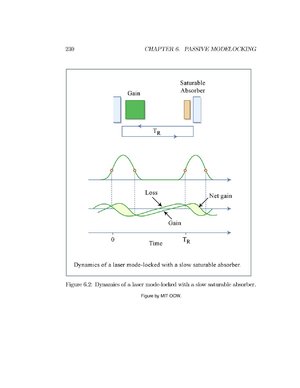
6.977 Ultrafast Optics
This course is offered to graduate students and addresses issues regarding ultrafast optics. Topics covered include: Generation, propagation and applications of ultrashort pulses (nano-, pico-, femto-, attosecond pulses); Linear and nonlinear pulse shaping processes: Optical solitons, Pulse compression; Laser principles: Single- and multi-mode laser dynamics, Q-switching, Active and passive mode-locking; Pulse characterization: Autocorrelation, FROG, SPIDER; Noise in mode-locked lasers and its limitations in measurements; Laser amplifiers, optical parametric amplifiers, and oscillators; Applications in research and industry: Pump-probe techniques, Optical imaging, Frequency metrology, Laser ablation, High harmonic generation.
Past and Present Energy Societies: How Energy Connects Politics, Technologies and Cultures
Abundant, salutary, problematic – energy makes history. As a symbol, resource and consumer good, it shapes technologies, politics, societies and cultural world views. Focussing on a range of energy types, from electricity and oil to bioenergy, this volume analyzes the social, cultural and political concepts and discourses of energy and their implementation and materialization within technical systems, applications, media representations and consumer practice. By examining and connecting production, mediation and consumption aspects from an international and interdisciplinary perspective, the book offers an innovative view on how energy is imagined, discussed, staged and used.

Zingend door het leven: Het Nederlandse liedboek in de Gouden Eeuw
The songbooks are a tangible reminder of the lively seventeenth-century song culture. Young and old, rich and poor: everyone sang, from the cradle to the grave. Natascha Veldhorst shows the diversity and originality of the genre. In addition, the book contains many surprising illustrations that underline how much singing and songbooks were integrated into daily life at the time. Songbooks were long loved by the Dutch population. The genre was invented in the sixteenth century, but remained popular for centuries afterwards. The Golden Age in particular flourished impressively, with hundreds of bundles in various sizes, prices and designs. The Dutch situation was unique in quantity and quality. Nowhere in Europe have the songbooks been produced and purchased with such energy and enthusiasm. Singing through life is devoted to this fascinating cultural-historical phenomenon. The book elaborates on the design and content of the songbooks, the relationship between newly composed and existing music, the influence of publishers and printers, the connections between song culture and theater, the popularity of amorous songbooks with young people, and religious resistance to the compelling influence of music. Thematic chapters are interspersed with twelve short interludes about individual songbooks, which show the great diversity and originality of the genre. Surprising illustrations emphasize how much the songbooks were integrated into everyday life. Song books, paintings and prints are a tangible reminder of our lively seventeenth-century song culture. Young and old, rich and poor: everyone sang, from the cradle to the grave.