
Books
Global Solutions, International Partnerships: The European Investment Bank Development Report 2021
The climate crisis and the COVID-19 pandemic remind us that we cannot face down our challenges alone—our solutions must be global. The European Investment Bank is at the heart of the push to turn EU policy initiatives into real development solutions on the ground. This report provides insights into our vital projects and initiatives outside the European Union, data on their impact and ideas for the future of development through a series of expert essays.

Gemeinsame Elternverantwortung – Eine rechtsvergleichende Studie zu Grundfragen und Problemen beim Elternkonflikt getrennt lebender Eltern
In this volume, the law of parental responsibility in Europe is examined on a comparative basis for Belgium, Germany, England and Wales, the Netherlands, Poland and Sweden. This closes a gap in the research, as there is currently no such current study available. A presentation of the main features of the law of parental responsibility is followed by a comparative typification and analysis of the rules regarding the exercise of joint parental responsibility and the legal representation of the child in cases of parental separation; those rules are explored from the point of view of the tension between parental autonomy and enforced parental cooperation. The legal solutions to parental conflicts are a further focal point; this is dealt with in depth regarding parental conflicts over the child’s place of residence and legal rules about alternating residence of the child in Australia, Belgium and Sweden. Volume 21 of the series “Göttinger Juristische Schriften” (Göttingen Legal Writings) The series is published by the Faculty of Law of the Georg-August-University and makes faculty activities accessible to an interested public.

Finance in Africa: for green, smart and inclusive private sector development
Africa’s recovery from the COVID-19 crisis will depend on private firms sustaining and creating jobs. But even previously thriving enterprises have been badly hit by the crisis. This report outlines the consequences of the health crisis in Africa, the potential cost of the recovery and the willingness of banks to support green investments as they look to the future.
European Investment Bank Activity Report 2021: The innovation response
Our flagship report illustrates how the European Investment Bank Group confronted two great threats in 2021, the climate crisis and the coronavirus pandemic, even as the challenges posed by development grew more urgent. The EU bank tackled these hazards by thinking hard and moving fast — in new directions. The Activity Report highlights our emergency response to COVID-19 through the unique European Guarantee Fund, as well as our support for healthcare companies working on cures and therapies for the disease. It illustrates the dimensions of our backing for companies that are forging new frontiers of climate action — sometimes right into outer space. It demonstrates our commitment to a better future for all Europeans in our cohesion investment and for all global citizens through our development work. Built around 25 articles about the work of the European Investment Bank and the European Investment Fund in COVID-19 response, climate action, cohesion and development, the Activity Report highlights our contribution to a healthy, green and inclusive world. Figures are expected outcomes of financed new operations signed in 2021 for the first time based on available data at this stage. All figures are unaudited and provisional.

European Investment Advisory Hub Report 2020
The COVID-19 outbreak upended normal life and forced us to rethink the way we went about our day-to-day activities. In spite of the many challenges we faced in 2020, we offered many advisory solutions that shortened the path to recovery. We also did not stop our work on climate change. Our advisory services have been key to helping clients keep their long-term investment plans on track, laying the foundations for a green and digital recovery.

European firms and climate change 2020/2021
The European Union’s COVID-19 recovery plan could be the impetus businesses need to invest in climate measures and prepare for the transition to a net-zero carbon economy. Our newest climate report looks at how firms’ view these twin challenges and their preparedness to meet them. Firms are more aware of the physical risks posed by climate change, but less aware of the risks caused by the transition to clean energy. Almost half of EU firms surveyed are investing in climate change measures, compared with roughly one-third of US firms. Uncertainty over regulation and taxation continues to hamper climate investments. To green its economy, Europe needs a comprehensive strategy that will provide businesses with the guidance they need to invest in climate preparedness and the energy transition.

EIB Investment Survey 2021 – EU overview
This unique insight into the corporate investment landscape in the European Union examines companies’ finance needs and the constraints they face. The 2021 edition delves into the massive shock produced by the COVID-19 crisis, and the response and recovery programmes put in place by the European Union and by national governments. The report assesses the extent to which European firms are addressing the need make their businesses more green and digital. The survey is based on interviews with 12 000 companies across the 27 European Union countries, and it includes a benchmark sample from the United Kingdom and United States. This overview provides the aggregated results for the European Union. Results for individual countries will be published in January 2022.

EIB Impact Report 2020: Climate action, environmental sustainability and innovation for decarbonisation
Investments supported by the European Investment Bank help achieve EU and international policy goals. The report specifically measures the effectiveness of our investments in three key areas: Additionality: the EIB’s role is to step in where the market has failed to deliver. Specifically, the EIB examines how our support for a project strengthens it compared to what would have happened without our involvement. Impact: The EIB now measures how its investments contribute to the United Nations Sustainable Development Goals (SDGs). By doing so, the EIB is signalling its commitment to supporting the United Nations’ Decade of Action to create peace and prosperity for people and the planet. Climate: The 2021 report focuses on barriers to investment in climate action, environmental sustainability and research and development and innovation for the decarbonisation of energy-intensive industries.

Digitalisation in Europe 2020-2021
Taking an early lead on digitalisation is crucial to Europe’s lasting competitiveness. Our newest digitalisation report sheds light on the state of digitalisation in European countries: The adoption of digital technologies by firms in the European Union is improving, but it has not yet closed the gap with the United States; While some EU countries are at the global forefront of digital transformation, others risk being left behind. Digitalisation provides a unique opportunity to improve European firms’ global competitiveness. To close the digital divide, Europe needs to increase investment and to create ecosystems that support innovation.

Annual Report 2020 on EIB Activity in Africa, the Caribbean, the Pacific, and the Overseas Countries and Territories
The European Investment Bank is helping African, Caribbean and Pacific countries in parts of society that are sometimes forgotten — young people, women and girls, small companies, rural villages. We are creating opportunities for everyone. In this report, you can meet the people who are making a difference for themselves and for others. There are stories on the COVID-19 pandemic as well as a wider range of healthcare challenges. We speak to the head of the United Nations Development Programme about the Sustainable Development Goals. There are stories about female entrepreneurs in the Dominican Republic and the financing of farmers in Malawi. What all the people and places have in common is the need for good advice and investment. Please read this annual report in conjunction with the financial statements.
The 15 circular steps for cities – Second edition
The transition to a circular economy not only conserves resources, but also reduces environmental and climate impacts. It fosters innovation and thereby increases competitiveness and creates new jobs. Cities can be cradles and catalysts for a circular transition. This guide provides concrete guidance on how a linear city can start the circular journey.

Queering Translation, Translating the Queer: Theory, Practice, Activism
This groundbreaking work is the first full book-length publication to critically engage in the emerging field of research on the queer aspects of translation and interpreting studies. The volume presents a variety of theoretical and disciplinary perspectives through fifteen contributions from both established and up-and-coming scholars in the field to demonstrate the interconnectedness between translation and queer aspects of sex, gender, and identity. The book begins with the editors’ introduction to the state of the field, providing an overview of both current and developing lines of research, and builds on this foundation to look at this research more closely, grouped around three different sections: Queer Theorizing of Translation; Case Studies of Queer Translations and Translators; and Queer Activism and Translation. This interdisciplinary approach seeks to not only shed light on this promising field of research but also to promote cross fertilization between these disciplines towards further exploring the intersections between queer studies and translation studies, making this volume key reading for students and scholars interested in translation studies, queer studies, politics, and activism, and gender and sexuality studies.

Gelehrte Lebensläufe – Habitus, Identität und Wissen um 1500
Attend a university? Get married? Graduate? 500 years ago, young men saw themselves already confronted with these questions, however compared to our days, under different social circumstances. Johannes Eck (1486–1543), Johannes Kingsattler (1486–1534) and Willibald Pirckheimer (1470–1530) were part of a precarious generation since they had to find their social positions in a rapidly changing society. How did they become the men, they themselves represented in their „self-narratives“ and that we know today? Ingo Trüter examines the conditions which enabled the protagonists of this study to attain certain positions in the field of learning without assuming a biographical telos. Based on multiple types of sources and following a micro-historical approach, the study draws an illustrative image of men of learning around the year 1500, ranging from philosophical questions in the Wegestreit to the learned men’s furniture and interior fittings of their houses.

Queer in Africa: LGBTQI Identities, Citizenship, and Activism
African sexualities are dynamic, multi-faceted and resilient. However, people with non-heterosexual sexualities and gender variant identities are often involved in struggles for survival, self-definition, and erotic rights. Queer in Africa forms an entry point for understanding the vulnerabilities of queer Africans as shaped by social, cultural and political processes, aiming to provide innovative insights about contentious disagreements over their lives. The volume mediates Southern and Northern scholarship, directing attention toward African-centred beliefs made accessible to a wide audience. Key concerns such as identity construction and the intersections between different social forces (such as nationalist traditionalism and sexualities) are addressed via engaging chapters; some empirically based and others providing critical cultural analysis.
Highly interdisciplinary in nature, Queer in Africa provides a key resource for students, academics, and activists concerned with the international support of sex and gender diversity. It will appeal to those interested in fields such as anthropology, film studies, literary studies, political science, public health, sociology, and socio-legal studies.
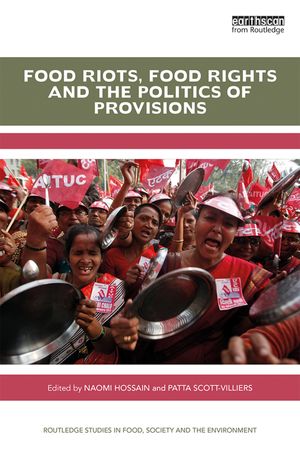
Food Riots, Food Rights and the Politics of Provisions
Thousands of people in dozens of countries took to the streets when world food prices spiked in 2008 and 2011. What does the persistence of popular mobilization around food tell us about the politics of subsistence in an era of integrated food markets and universal human rights? This book interrogates this period of historical rupture in the global system of subsistence, getting behind the headlines and inside the politics of food for people on low incomes.
The half decade of 2007–2012 was a period of intensely volatile food prices as well as unusual levels of popular mobilization, including protests and riots. Detailed case studies are included here from Bangladesh, Cameroon, India, Kenya and Mozambique. The case studies illustrate that political cultures and ways of organizing around food share much across geography and history, indicating common characteristics of the popular politics of provisions under capitalism. However, all politics are ultimately local, and it is demonstrated how the historic fallout of a subsistence crisis depends ultimately on how the actors and institutions articulate, negotiate and reassert their specific claims within the peculiarities of each policy.
A key conclusion of the book is that the politics of provisions remain essential to the right to food and that they involve unruliness. In other words, food riots work. The book explains how and why they continue to do so even in the globalized food system of the 21st century. Food riots signal a state unable to meet a principal condition of its social contract, and create powerful pressure to address that most fundamental of failings.

Discourse in Translation
This book explores the discourse in and of translation within and across cultures and languages. From the macro aspects of translation as an inter- cultural project to actual analysis of textual ingredients that contribute to translation and interpreting as discourse, the ten chapters represent different explorations of ‘global’ theories of discourse and translation. Offering interrogations of theories and practices within different sociocultural environments and traditions (Eastern and Western), Discourse in Translation considers a plethora of domains, including historiography, ethics, technical and legal discourse, subtitling, and the politics of media translation as representation. This is key reading for all those working on translation and discourse within translation studies and linguistics.

World Literature and Dissent
World Literature and Dissent reconsiders the role of dissent in contemporary global literature. Bringing together scholars of world and postcolonial literatures, the contributors explore the aesthetics of resistance through concepts including the epistemology of ignorance, the rhetoric of innocence, the subversion of paying attention, and the radical potential of everydayness.
Addressing a broad range of examples, from the Maghrebian humanist Ibn Khaldūn to India’s Facebook poets and examining writers such as Langston Hughes, Ben Okri, Sara Uribe, and Merle Collins, this highly relevant book reframes the field of world literature in relation to dissenting politics and aesthetic. It asks the urgent question: how critical practice might cultivate radical thought, further social justice, and value human expression?
The Work of Communication: Relational Perspectives on Working and Organizing in Contemporary Capitalism
The Work of Communication: Relational Perspectives on Working and Organizing in Contemporary Capitalism revolves around a two-part question: “What have work and organization become under contemporary capitalism—and how should organization studies approach them?” Changes in the texture of capitalism, heralded by social and organizational theorists alike, increasingly focus attention on communication as both vital to the conduct of work and as imperative to organizational performance. Yet most accounts of communication in organization studies fail to understand an alternate sense of the “work of communication” in the constitution of organizations, work practices, and economies. This book responds to that lack by portraying communicative practices—as opposed to individuals, interests, technologies, structures, organizations, or institutions—as the focal units of analysis in studies of the social and organizational problems occasioned by contemporary capitalism. Rather than suggesting that there exists a canonically “correct” route communicative analyses must follow, The Work of Communication: Relational Perspectives on Working and Organizing in Contemporary Capitalism explores the value of transcending longstanding divides between symbolic and material factors in studies of working and organizing. The recognition of dramatic shifts in technological, economic, and political forces, along with deep interconnections among the myriad of factors shaping working and organizing, sows doubts about whether organization studies is up to the vital task of addressing the social problems capitalism now creates. Kuhn, Ashcraft, and Cooren argue that novel insights into those social problems are possible if we tell different stories about working and organizing. To aid authors of those stories, they develop a set of conceptual resources that they capture under the mantle of communicative relationality. These resources allow analysts to profit from burgeoning interest in notions such as sociomateriality, posthumanism, performativity, and affect. It goes on to illustrate the benefits that investigations of work and organization can realize from communicative relationality by presenting case studies that analyze (a) the becoming of an idea, from its inception to solidification, (b) the emergence of what is taken to be the “the product” in high-tech startup entrepreneurship, and (c) the branding of work (in this case, academic writing and commercial aviation) through affective economies. Taken together, the book portrays “the work of communication” as simultaneously about how work in the “new economy” revolves around communicative practice and about how communication serves as a mode of explanation with the potential to cultivate novel stories about working and organizing. Aimed at academics, researchers, and policy makers, this book’s goal is to make tangible the contributions of communication for thinking about contemporary social and organizational problems.
Teacher Education for Sustainable Development and Global Citizenship: Critical Perspectives on Values, Curriculum and Assessment
This book examines how educators internationally can better understand the role of education as a public good designed to nurture peace, tolerance, sustainable livelihoods and human fulfilment.Bringing together empirical and theoretical perspectives, this insightful text develops new understandings of education for sustainable development and global citizenship (ESD/GC) and illustrates how these might impact on educational research, policy and practice. The text recognizes the ESD/GC as pivotal to the universal ambitions of UNESCO’s Sustainable Development Goals, and focuses on the role of teachers and teacher educators in delivering the appropriate educational response to promote equity and sustainability. Chapters explore factors including curriculum design, values and assessment in teacher education, and consider how each and every learner can be guaranteed an understanding of their role in promoting a just and sustainable global society.This book will be of great interest to academics, researchers, school leaders, practitioners, policy makers and students in the fields of education, teacher education and sustainability.

Social Networks as the New Frontier of Terrorism: #Terror
Terrorism. Why does this word grab our attention so? Propaganda machines have adopted modern technology as a means to always have their content available. Regardless of the hour or time zone, information is being shared by somebody, somewhere. Social media is a game changer influencing the way in which terror groups are changing their tactics and also how their acts of terror are perceived by the members of the public they intend to influence.This book explores how social media adoption by terrorists interacts with privacy law, freedom of expression, data protection and surveillance legislation through an exploration of the fascinating primary resources themselves, covering everything from the Snowden Leaks, the rise of ISIS to Charlie Hebdo. The book also covers lesser worn paths such as the travel guide that proudly boasts that you can get Bounty and Twix bars mid-conflict, and the best local hair salons for jihadi brides. These vignettes, amongst the many others explored in this volume bring to life the legal, policy and ethical debates considered in this volume, representing an important part in the development of understanding terrorist narratives on social media, by framing the legislative debate.This book represents an invaluable guide for lawyers, government bodies, the defence services, academics, students and businesses.
Slogans: Subjection, Subversion, and the Politics of Neoliberalism
Focusing on contexts of accelerated economic and political reform, this volume critically examines the role of slogans in the contemporary projects of populist mobilization, neoliberal governance, and civic subversion. Bringing together a collection of ethnographic studies from Greece, Slovakia, Poland, Abu Dhabi, Peru, and China, the contributors analyze the way in which slogans both convey and contest the values and norms that lie at the core of hegemonic political economic projects and ideologies.

Queering Knowledge: Analytics, Devices, and Investments after Marilyn Strathern
This volume draws on the significance of the work of Marilyn Strathern in respect of its potential to queer anthropological analysis and to foster the reimagining of the object of anthropology.The authors examine the ways in which Strathern’s varied analytics facilitate the construction of alternative forms of anthropological thinking, and greater understanding of how knowledge practices of queer objects, subjects and relations operate and take effect. Queering Knowledge offers an innovative collection of writing, bringing about queer and anthropological syntheses through Strathern’s oeuvre. It will be relevant to scholars from anthropology as well as a number of other disciplines, including gender, sexuality and queer studies.*Winner of the 2020 Ruth Benedict Prize for Outstanding Edited Volume*
Poverty, Inequality and Growth in Developing Countries: Theoretical and empirical approaches
There are many problems regarding poverty, inequality and growth in developing countries in Asia and Africa. Policy makers at the national level and at international institutions such as the United Nations, World Bank, International Monetary Fund and others have implemented various policies in order to decrease poverty and inequality. This book provides empirical observations on Asian countries and Africa. Each chapter provides theoretical and empirical analysis on regional case studies with an emphasis on policy implications. The book will be of use to many who wish to assess and improve policies in developing countries and mitigate poverty and inequality, and stimulate growth, by drawing on relevant empirical research and economic theories. Clearly, there have been numerous policy failures and the book aims to provide a basis for improving policies and outcomes based on relevant empirical observations.

Gegenwärtiger Rassismus in Deutschland – Zwischen Biologie und kultureller Identität
Kaum ein anderes Thema polarisierte die bundesrepublikanische Öffentlichkeit in den vergangenen Jahren so nachhaltig wie die Veröffentlichung der tendenziell rassistischen Theoreme Thilo Sarrazins im Sommer 2010. Rassistische Ressentiments zeigten sich hier wieder als in vielen Teilen der deutschen Gesellschaft etabliert und debattiert, wie der Verkaufserfolg von Sarrazins Bestseller „Deutschland schafft sich ab“ demonstriert. Die vorliegende Arbeit fokussiert dieses gegenwärtige, insbesondere biologisch-genetische Rassismusphänomen in der bundesrepublikanischen Gesellschaft im Zeitraum von 2007 bis 2013. Sie analysiert die Verbreitung, die Entstehungsbedingungen sowie die naturwissenschaftliche Realität biologistischer, rassistischer Argumentationen in Deutschland. Hierfür nutzt diese Arbeit einen kombinierten Forschungsansatz von Sozial- und Naturwissenschaften, um das gegenwärtige Rassismusphänomen sowohl aus sozialwissenschaftlicher als auch aus biologischer Perspektive zu analysieren und zu beurteilen.

Posthumanism and Deconstructing Arguments: Corpora and Digitally-driven Critical Analysis
Posthumanism and Deconstructing Arguments: Corpora and Digitally-driven Critical Analysis presents a new and practical approach in Critical Discourse Studies. Providing a data-driven and ethically-based method for the examination of arguments in the public sphere, this ground-breaking book:Highlights how the reader can evaluate arguments from points of view other than their own;Demonstrates how digital tools can be used to generate ‘ethical subjectivities’ from large numbers of dissenting voices on the world-wide-web;Draws on ideas from posthumanist philosophy as well as from Jacques Derrida, Gilles Deleuze and Félix Guattari for theorising these subjectivities;Showcases a critical deconstructive approach, using different corpus linguistic programs such as AntConc, WMatrix and Sketchengine.Posthumanism and Deconstructing Arguments is essential reading for lecturers and researchers with an interest in critical discourse studies, critical thinking, corpus linguistics and digital humanities.

Online Misogyny as Hate Crime: A Challenge for Legal Regulation?
The ideal of an inclusive and participatory Internet has been undermined by the rise of misogynistic abuse on social media platforms. However, limited progress has been made at national – and to an extent European – levels in addressing this issue. In England and Wales, the tackling of underlying causes of online abuse has been overlooked because the law focuses on punishment rather than measures to prevent such abuses. Furthermore, online abuse has a significant impact on its victims that is underestimated by policymakers. This volume critically analyses the legal provisions that are currently deployed to tackle forms of online misogyny, and focuses on three aspects; firstly, the phenomenon of social media abuse; secondly, the poor and disparate legal responses to social media abuses; and thirdly, the similar failings of hate crime to tackle problems of online gender-based abuses. This book advances a compelling argument for legal changes to the existing hate crime, and communications legislation.
News Literacy and Democracy
News Literacy and Democracy invites readers to go beyond surface-level fact checking and to examine the structures, institutions, practices, and routines that comprise news media systems.This introductory text underscores the importance of news literacy to democratic life and advances an argument that critical contexts regarding news media structures and institutions should be central to news literacy education. Under the larger umbrella of media literacy, a critical approach to news literacy seeks to examine the mediated construction of the social world and the processes and influences that allow some news messages to spread while others get left out. Drawing on research from a range of disciplines, including media studies, political economy, and social psychology, this book aims to inform and empower the citizens who rely on news media so they may more fully participate in democratic and civic life.The book is an essential read for undergraduate students of journalism and news literacy and will be of interest to scholars teaching and studying media literacy, political economy, media sociology, and political psychology.

Literature and the World
Literature and the World presents a broad and multifaceted introduction to world literature and globalization. The book provides a brief background and history of the field followed by a wide spectrum of exemplary readings and case studies from around the world. Amongst other aspects of World Literature, the authors look at:New approaches to digital humanities and world literatureEcologies of world literatureRethinking geography in a globalized worldTranslation Race and political economyOffering state of the art debates on world literature, this volume is a superb introduction to the field. Its critically thoughtful approach makes this the ideal guide for anyone approaching World Literature.

The Language of Jokes in the Digital Age: Viral Humour
In this accessible book, Delia Chiaro provides a fresh overview of the language of jokes in a globalized and digitalized world. The book shows how, while on the one hand the lingua-cultural nuts and bolts of jokes have remained unchanged over time, on the other, the time-space compression brought about by modern technology has generated new settings and new ways of joking and playing with language. The Language of Jokes in the Digital Age covers a wide range of settings from social networks, e-mails and memes, to more traditional fields of film and TV (especially sitcoms and game shows) and advertising. Chiaro’s consideration of the increasingly virtual context of jokes delights with both up-to-date examples and frequent reference to the most central theories of comedy. This lively book will be essential reading for any student or researcher working in the area of language and humour and will be of interest to those in language and media and sociolinguistics.

Human Minds and Animal Stories: How Narratives Make Us Care About Other Species
The power of stories to raise our concern for animals has been postulated throughout history by countless scholars, activists, and writers, including such greats as Thomas Hardy and Leo Tolstoy. This is the first book to investigate that power and explain the psychological and cultural mechanisms behind it. It does so by presenting the results of an experimental project that involved thousands of participants, texts representing various genres and national literatures, and the cooperation of an internationally-acclaimed bestselling author. Combining psychological research with insights from animal studies, ecocriticism and other fields in the environmental humanities, the book not only provides evidence that animal stories can make us care for other species, but also shows that their effects are more complex and fascinating than we have ever thought. In this way, the book makes a groundbreaking contribution to the study of relations between literature and the nonhuman world as well as to the study of how literature changes our minds and society. “As witnessed by novels like Black Beauty and Uncle Tom’s Cabin, a good story can move public opinion on contentious social issues. In Human Minds and Animal Stories a team of specialists in psychology, biology, and literature tells how they discovered the power of narratives to shift our views about the treatment of other species. Beautifully written and based on dozens of experiments with thousands of subjects, this book will appeal to animal advocates, researchers, and general readers looking for a compelling real-life detective story.” – Hal Herzog, author of Some We Love, Some We Hate, Some We Eat : Why It’s So Hard To Think Straight About Animals