
Books

China’s Allocation of Fixed Capital Investment, 1952–1957
China’s efforts to stimulate industrial development and economic growth through the allocation of investments are analyzed. Cheng concludes with an overall assessment of the distinctive features of the allocation pattern. Includes 41 statistical tables.
Change and the Persistence of Tradition in India: Five Lectures
The lectures presented in this volume were given during the summer of 1970 under the sponsorship of the CIC Summer Program on South Asia and the Center for South and Southeast Asian Studies of the University of Michigan. It should be recognized that these essays appear in revised lecture form, and not as fully polished scholarly papers. They carry nevertheless the authority—and no little verve—of experienced scholars concerned with both the traditions and the changes so characteristic of modern India.
Chang Ch’un-ch’iao and Shanghai’s January Revolution
Shanghai’s January Revolution was a highly visible and, by all accounts, crucially important event in China’s Cultural Revolution. Its occurrence, along with the subsequent attempt to establish a “commune” form of municipal government, has greatly shaped our understanding both of the goals originally envisaged for the Cultural Revolution by its leaders and of the political positions held by the new corps of Party leaders thrust upward during its course—most notably Chang Ch’un ch’iao. At this interpretive level, the events in Shanghai seem to embody in microcosm the issues and conflicts in Chinese politics during the Cultural Revolution as a whole, while at the same time shaping our conception of what these larger issues and conflicts were. At the more general, theoretical level, however, the events in Shanghai provide us with an unusual opportunity (thanks to Red Guard raids on Party offices) to view the internal workings of the Party organization under a period of stress and to observe unrestrained interest group formation and mass political conflict through the press accounts provided by these unofficial groups themselves. The January Revolution thus provides us with an opportunity to develop better our more abstract, theoretical understanding of the functioning of the Chinese political system and the dynamics of the social system in which it operates.
Central Documents and Politburo Politics in China
Virtually every analysis of Chinese politics views the Politburo as the nerve center of the system, but questions abound as to how this center governs itself and how it interacts with the system around it. Specifically, how much consultation occurs during the drafting of major Politburo documents, and who is brought into this process? How is information channeled up to this body, and what are the rules that govern the access of the Politburo members themselves to data generated by the bureaucracies? How are the political strategies of individual leaders and political factions attuned to this system of information channeling? What types of decisions are reached by the Politburo? To whom are they communicated? How rigidly must they be followed? How institutionalized is this entire decision making system, and has it become more—or less—institutionalized over the years? How has the factional legacy of the Cultural Revolution affected its mode of operations? Indeed, in the wake of the Cultural Revolution, how much in control of the system has the Politburo itself been?
Central Documents in Politburo Politics in China seeks to better understand these questions by analyzing a particular stream of largely bureaucratic communications in the Chinese system: the so-called “Central Documents” (CDs). This is a series of documents through which the top Party leadership directly communicates with the rest of the political system.

A Cemetery and Quarry from Imperial Gabii
Since 2009, the Gabii Project, an international archaeological initiative led by Nicola Terrenato and the University of Michigan, has been investigating the ancient Latin town of Gabii, which was both a neighbor of, and a rival to, Rome in the first millennium BC. The story of Gabii, like that of many ancient cities, is one of growth, transformation, and diminishment. In this volume, editors Laura M. Banducci and Anna Gallone highlight the close but sometimes tense relationship between where people live, work, trade, and bury their dead. We learn that, contrary to what you may have read elsewhere about the Roman world, the distinction between spaces of the living and spaces of the dead was not so clear-cut. Areas considered to be “within the city,” or what “being in the city” implied shifted in the minds of the locals as their priorities and needs changed. Assembled in an innovative digital format, the story of the site is presented three times in a “layered” structure: the first, titled “The Story,” explains the narrative of the excavation area in a simple chronological way. The second layer, “More,” contains the explanation of the phasing and the features of the site and their interpretation. The third layer contains the stratigraphic description and the technical reports on specialist materials. The volume is beautifully illustrated with traditional photographs and drawings, as well as an interactive 3D model based on photogrammetric models produced at the time of excavation. The 3D model is linked throughout the text by individual stratigraphic unit numbers and archaeological features. A series of interactive maps of the site, including GIS line-drawings and orthorectified aerial photographs, provide further spatial details.

Campaign Finance and Political Polarization: When Purists Prevail
Efforts to reform the U.S. campaign finance system typically focus on the corrupting influence of large contributions. Yet, as Raymond J. La Raja and Brian F. Schaffner argue, reforms aimed at cutting the flow of money into politics have unintentionally favored candidates with extreme ideological agendas and, consequently, fostered political polarization.
Drawing on data from 50 states and the U.S. Congress over 20 years, La Raja and Schaffner reveal that current rules allow wealthy ideological groups and donors to dominate the financing of political campaigns. In order to attract funding, candidates take uncompromising positions on key issues and, if elected, take their partisan views into the legislature. As a remedy, the authors propose that additional campaign money be channeled through party organizations—rather than directly to candidates—because these organizations tend to be less ideological than the activists who now provide the lion’s share of money to political candidates. Shifting campaign finance to parties would ease polarization by reducing the influence of “purist” donors with their rigid policy stances.
La Raja and Schaffner conclude the book with policy recommendations for campaign finance in the United States. They are among the few non-libertarians who argue that less regulation, particularly for political parties, may in fact improve the democratic process.

Erziehen und Strafen, Bessern und Bewahren – Entwicklungen und Diskussionen im Jugendrecht im 20. Jahrhundert
Der vorliegende Band vereinigt die Referate eines am 27. Mai 2016 in Göttingen durchgeführten Workshops zur Entwicklung des Jugendfürsorge- und Jugendstrafrechts in Deutschland. Er beobachtet die Entwicklung dieser Rechtsgebiete in vier politischen Systemen vom Kaiserreich über die Weimarer Republik und den Nationalsozialismus bis in die Bundesrepublik. Auf der Grundlage von sechs Beiträgen werden u.a. das Verhältnis von Strafe und Erziehung, die Radikalisierung des Jugendrechts im Nationalsozialismus sowie die personellen Kontinuitäten und die Fortführung einzelner Diskurse und Ideen über das Jahr 1945 hinaus näher beleuchtet. Mehrere Beiträge beschäftigen sich zudem mit dem umstrittenen Göttinger Strafrechtler Friedrich Schaffstein und seinen Konzepten zum Jugendstrafrecht seit der Mitte der 1930er Jahre sowie ihren Einflüssen auf die jugendstrafrechtliche Diskussion in der Bundesrepublik.

Boundaries of the Text: Epic Performances in South and Southeast Asia
When the Mahabharata and Ramayana are performed in South and Southeast Asia, audiences may witness a variety of styles. A single performer may deliver a two-hour recitation, women may meet in informal singing groups, shadow puppets may host an all-night play, or professional theaters may put on productions lasting thirty nights. Performances often celebrate ritual passages: births, deaths, marriages, and religious observances. The stories live and are transmitted through performance; their characters are well known and well loved.Yet written versions of the Mahabharata and Ramayana have existed in both South and Southeast Asia for hundreds of years. Rarely have these texts been intended for private reading. What is the relationship between written text and oral performance? What do performers and audiences mean when they identify something as “Ramayana” or “Mahabharata”? How do they conceive of texts? What are the boundaries of the texts?
By analyzing specific performance traditions, Boundaries of the Text addresses questions of what happens to written texts when they are preformed and how performance traditions are affected when they interact with written texts. The dynamics of this interaction are of particular interest in South and Southeast Asia where oral performance and written traditions share a long, interwoven history. The contributors to Boundaries of the Text show the difficulty of maintaining sharp distinctions between oral and written patterns, as the traditions they consider defy a unidirectional movement from oral to written. The boundaries of epic traditions are in a state of flux, contracting or expanding as South and Southeast Asian societies respond to increasing access to modern education, print technology, and electronic media.

Big Digital Humanities: Imagining a Meeting Place for the Humanities and the Digital
Big Digital Humanities has its origins in a series of seminal articles Patrik Svensson published in the Digital Humanities Quarterly between 2009 and 2012. As these articles were coming out, enthusiasm around Digital Humanities was acquiring a great deal of momentum and significant disagreement about what did or didn’t “count” as Digital Humanities work. Svensson’s articles provided a widely sought after omnibus of Digital Humanities history, practice, and theory. They were informative and knowledgeable and tended to foreground reportage and explanation rather than utopianism or territorial contentiousness. In revising his original work for book publication, Svensson has responded to both subsequent feedback and new developments.
Svensson’s own unique perspective and special stake in the Digital Humanities conversation comes from his role as director of the HUMlab at Umeå University. HUMlab is a unique collaborative space and Digital Humanities center, which officially opened its doors in 2000. According to its own official description, the HUMlab is an open, creative studio environment where “students, researchers, artists, entrepreneurs and international guests come together to engage in dialogue, experiment with technology, take on challenges and move scholarship forward.” It is this last element “moving scholarship forward” that Svensson argues is the real opportunity in what he terms the “big digital humanities,” or digital humanities as practiced in collaborative spaces like the HUMlab, and he is uniquely positioned to take an account of this evolving dimension of Digital Humanities practice.
A Bibliography of Chinese Language Materials on the People’s Communes
A research tool for scholars studying modern China, particularly those focusing on the post-1949 communal system and economy. The work includes full bibliographic references to some 2,800 essay, articles, pamphlets, and other materials in Chinese taken from more than 130 publications, primarily from mainland. The entries are arranged are arranged topically with annotations. Includes a geographic index to the communes referred to in the listed items.
Beyond the Makerspace: Making and Relational Rhetorics
Makerspaces—local workshops that offer access to and training on fabrication technologies, often with a focus on creativity, education, and entrepreneurship—proliferated in the 2010s, popping up in cities across the world. Beyond the Makerspace is a longitudinal, ethnographically informed study of a particular Seattle makerspace that begins in 2015 and ends with the closing of the space in 2018. Examining acts of making with objects, tools, words, and relationships, Beyond the Makerspace reads making as a kind of rhetoric, or meaning-making work, and argues that acts of making things are rhetorical in the sense that they are culturally situated and that they mark boundaries of what counts as making and who counts as maker. By focusing on a particular makerspace over time, Shivers-McNair attends to a changing cohort of makerspace regulars as they face challenges of bringing their vision of inclusivity and diversity to fruition, and offers an examination of how makers are made (and unmade, and remade) in a makerspace.
Beyond the Makerspace contributes not only to our understanding of making and makerspaces, but also to our understanding of how to study making—and meaning making, more broadly—in ways that examine and intervene in the marking of difference. Thus, the book examines what (and whose) values and practices we are taking up when we identify as makers or when we turn a writing classroom or a library space into a makerspace.

Between Two Plenums: China’s Intraleadership Conflict, 1959–1962
The origins of the Cultural Revolution are still shrouded in uncertainty. Crucial questions either remain unanswered or have been given answers which derive from conflicting interpretations. To what period can the direct origins of the Cultural Revolution be traced? What issues, if any, divided the leadership, and how deep were these divisions? What was the state of power relations and what was Mao’s position? Why did developments in the period preceding the Cultural Revolution reach a climax in such a convulsion?Between Two Plenums examines these questions as they apply to the years 1959–1962. At base, the perspective of pre-Cultural Revolution politics adopted therein is that of “conflict” rather than “consensus.” From this vantage point, the Eighth and Tenth Plenums loom in retrospect as important watersheds in the development of the intraleadership conflict which culminated in the great upheaval.
Automobiles and the Future: Competition, Cooperation, and Change
At the time of the U.S.-Japan auto conferences in March 1983, the hoped-for economic recovery as manifested in auto sales had revealed itself quite modestly. Three months later, the indicators were more robust and certainly long overdue for those whose livelihood depends on the health of the industry–some of whom are university professors.
With Japanese import restrictions in place until March 1984 and drastically reduced break-even points for domestic manufactures, rising consumer demand holds great promise for the industry. The rapidly rising stock prices of the auto-makers captures well the sense of heightened optimism, as do the various forecasts for improved profits.
While the news is certainly welcome, it nevertheless should be greeted with caution. As Mr. Perkins noted at the conference, “we have a tendency to forget things very quickly. If we have a boom market this year, there is a good chance that a lot of things we learned will be forgotten.”To put the matter differently and more bluntly, with growing prosperity there is the risk that management will fall back into old habits, making impossible the achievement of sustained quality and productivity improvement. Similarly, the commitment to develop cooperative relations with workers and suppliers will weaken. The union will be under membership pressure to retrieve concessions rather than to take the longer-term view. This longer-term view recognizes that “up-front increases” and adherence to existing work rules increasingly come at the sacrifice of future job security. Government policymakers will turn their attention away from the industry. This may not mean a great deal given how weakly focused their attentions has been during the last three years and how mixed and contradictory government auto policies have been for over a decade.
Aryan and Non-Aryan in India
The history and mechanisms of the convergence of ancient Aryan and non-Aryan cultures has been a subject of continuing fascination in many fields of Indology. The contributions to Aryan and Non-Aryan in India are the fruit of a conference on that topic held in December 1976 at the University of Michigan, Ann Arbor, under the auspices of the Center for South and Southeast Asian Studies. The express object of the conference was to examine the latest findings from a variety of disciplines as they relate to the formation and integration of a unified Indian culture from many disparate cultural and ethnic elements.
Appropriation and Representation: Feng Menglong and the Chinese Vernacular Story
Feng Menglong (1574–1646) was recognized as the most knowledgeable connoisseur of popular literature of his time. He is known today for compiling three famous collections of vernacular short stories, each containing forty stories, collectively known as Sanyan.
Appropriation and Representation adapts concepts of ventriloquism and dialogism from Bakhtin and Holquist to explore Feng’s methods of selecting source materials. Shuhui Yang develops a model of development in which Feng’s approach to selecting and working with his source materials becomes clear.
More broadly, Appropriation and Representation locates Feng Menglong’s Sanyan in the cultural milieu of the late Ming, including the archaist movement in literature, literati marginality and anxieties, the subversive use of folk works, and the meiren xiangcao tradition—appropriating a female identity to express male frustration. Against this background, a rationale emerges for Feng’s choice to elevate and promote the vernacular story while stepping back form an overt authorial role.

An Annotated Bibliography of Chinese Painting Catalogues and Related Texts
The student of Chinese painting must from time to time consult John C. Ferguson’s Li-tai chu-lu hua mu, an index to Chinese paintings recorded in Chinese catalogues. The catalogues in which the paintings are compiled are of equal interest: their compilers, the date of their compilation, their scope, their derivation, their merits and shortcomings, and so on.An Annotated Bibliography of Chinese Painting Catalogues and Related Texts provides a way for English-language students with limited knowledge of Chinese to find basic information on the catalogues in an easily available form.

Animal Acts: Performing Species Today
We all have an animal story—the pet we loved, the wild animal that captured our childhood imagination, the deer the neighbor hit while driving. While scientific breakthroughs in animal cognition, the effects of global climate change and dwindling animal habitats, and the exploding interdisciplinary field of animal studies have complicated things, such stories remain a part of how we tell the story of being human. Animal Acts collects eleven exciting, provocative, and moving stories by solo performers, accompanied by commentary that places the works in a broader context.Work by leading theater artists Holly Hughes, Rachel Rosenthal, Deke Weaver, Carmelita Tropicana, and others joins commentary by major scholars including Donna Haraway, Jane Desmond, Jill Dolan, and Nigel Rothfels. Una Chaudhuri’s introduction provides a vital foundation for understanding and appreciating the intersection of animal studies and performance. The anthology foregrounds questions of race, gender, sexuality, class, nation, and other issues central to the human project within the discourse of the “post human,” and will appeal to readers interested in solo performance, animal studies, gender studies, performance studies, and environmental studies.

Erhard Weigel (1625-1699) und seine Schüler – Beiträge des 7. Erhard-Weigel-Kolloquiums 2014
Erhard Weigel (1625-1699) was a German mathematician, astronomer, educator, philosopher, and inventor. He was professor of mathematics at Jena University and is considered a key figure in the development of the mathematical sciences of the 17th Century. In particular, he is known to be the teacher of the young Gottfried Wilhelm Leibniz (1646-1716) and other notable students. These proceedings record papers presented at an international colloquium held at the Göttingen State and University Library in collaboration with the Erhard Weigel Society based in Jena on December 5-6, 2014. The colloquium was concerned with Erhard Weigel and some of his many students as well as discussed his contribution to the history of science as an excellent educator. Moreover, the colloquium dealt with the flow of impact of his methods and ideas into the scientific community, whose members played a significant role in the scientific revolution of the 17th Century. Finally, a list of known students who attended Weigel’s lectures is given.

American Homes
Poetry / Fiction / Art / Aphorisms. American Homes incorporates poetry, prose, and various schematic devices, including dozens of illustrations by the artist Jacob Heustis, to create a cracked narrative of the domestic spaces we inhabit.
The American Automobile Industry: Rebirth or Requiem?
Amid the gloom, indeed the despair, that prevailed among auto industry spokesmen during early 1981, the University of Michigan held the first U.S.-Japan Auto Conference. With all the uncertainty that accompanies a march into new territory, the conference very much resembled a call to arms as industry, union, and government officials sought to comprehend and respond to the Japanese challenge. In the subsequent two conferences in 1982 and 1983, the concerned parties displayed an impressive willingness to roll up their sleeves and get on with creating the conditions for a renewal of the industry. Yet success seemed to elude their efforts, and frustrations mounted as the national recession lengthened and deepened.It was not until the March 1984 conference that definite change in tone became apparent. By this time, it was clear that the industry was beginning to reap the fruits of its efforts. As Paul McCracken notes in his remarks, the market for new cars was manifesting its traditional high-geared response to improved business conditions, and the voluntary trade restraints were contributing to the ability of the industry to take advantage of this renewed prosperity. In addition, those who know the industry well knew that the major improvements in quality and productivity had been made, and many of the changes responsible for these improvements seem unlikely to be reversed. All this was much on the minds of speakers and participants during the March conference. The various speakers presented an image of people who thought that they were pretty much on the way toward addressing successfully their internal problems of productivity, quality, and marketing. All that remained was to dispose of the external factors that prevented the, from competing on that well-known if elusive “level playing field.”

The American and Japanese Auto Industries in Transition: Report of the Joint U.S.–Japan Automotive Study
This report was prepared for the Policy Board by the U.S. and Japanese research staffs of the Joint U.S.–Japan Automotive Study under the general direction of Professors Paul W. McCracken and Keichi Oshima, with research operations organized and coordinated by Robert E. Cole on the U.S. side, in close communication with the Taizo Yakushiji on the Japanese side.
In view of the importance of stable, long-term economic relationships between Japan and the United States, automotive issues have to be dealt with in ways consistent with the joint prosperity of both countries. Furthermore, the current economic friction has the potential to adversely affect future political relationships. Indeed, under conditions of economic stagnation, major economic issues inevitably become political issues.With these considerations in mind, the Joint U.S.–Japan Automotive Study project was started in September 1981 to determine the conditions that will allow for the prosperous coexistence of the respective automobile industries. During this two-year study, we have identified four driving forces that will play a major role in determining the future course of the automotive industry of both countries. These are: (1) consumers’ demands and aspirations vis-à-vis automobiles; (2) flexible manufacturing systems (FMS); (3) rapidly evolving technology; and (4) the internationalization of the automotive industry.

Sounds of the Underground: A Cultural, Political and Aesthetic Mapping of Underground and Fringe Music
In basements, dingy backrooms, warehouses, and other neglected places around the world music is being made that doesn’t fit neatly into popular or classical categories and genres, whose often extreme sounds and tiny concerts hover on the fringes of these commercial and cultural mainstreams.
The term “underground music” as it’s being used here connects various forms of music-making that exist outside or on the fringes of mainstream institutions and culture, such as noise, free improvisation, and extreme metal. This is music that makes little money, that’s noisy and exploratory in sound and that’s largely independent from both the market and from traditional high art institutions. In this book, by outlining the historical background but focusing on the digital age, the underground and its fringes can be seen as based in radical anti-capitalist politics or radical aesthetics while also being tied to the political contexts and structures of late capitalism.

Shipwrecked: Disaster and Transformation in Homer, Shakespeare, Defoe, and the Modern World
This book presents the first comparative study of notable literary shipwrecks from the past four thousand years, focusing on Homer’s Odyssey, Shakespeare’s The Tempest, and Defoe’s Robinson Crusoe. James V. Morrison considers the historical context as well as the “triggers” (such as the 1609 Bermuda shipwreck) that inspired some of these works, and modern responses such as novels (Golding’s Lord of the Flies, Coetzee’s Foe, and Gordon’s First on Mars, a science fiction version of the Crusoe story), movies, television (Forbidden Planet, Cast Away, and Lost), and the poetry and plays of Caribbean poets Derek Walcott and Aimé Césaire.
For survivors who are stranded on an island for some period of time, shipwrecks often present the possibility of a change in political and social status—as well as romance and even paradise. In each of the major shipwreck narratives examined, the poet or novelist links the castaways’ arrival on a new shore with the possibility of a new sort of life.
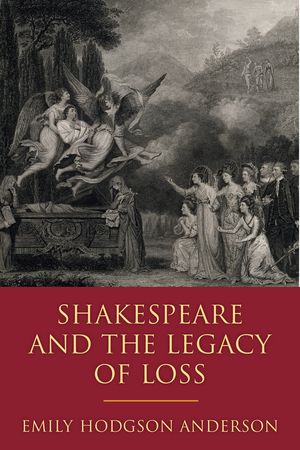
Shakespeare and the Legacy of Loss
How do we recapture, or hold on to, the live performances we most love, and the talented artists and performers we most revere? Shakespeare and the Legacy of Loss tells the story of how 18th-century actors, novelists, and artists, key among them David Garrick, struggled with these questions through their reenactments of Shakespearean plays. For these artists, the resurgence of Shakespeare, a playwright whose works just decades earlier had nearly been erased, represented their own chance for eternal life. Despite the ephemeral nature of performance, Garrick and company would find a way to make Shakespeare, and through him the actor, rise again.
In chapters featuring Othello, Richard III, Hamlet, The Winter’s Tale, and The Merchant of Venice, Emily Hodgson Anderson illuminates how Garrick’s performances of Shakespeare came to offer his contemporaries an alternative and even an antidote to the commemoration associated with the monument, the portrait, and the printed text.

Good Vibrations: Brian Wilson and the Beach Boys in Critical Perspective
Good Vibrations brings together scholars with a variety of expertise, from music to cultural studies to literature, to assess the full extent of the contributions to popular culture and popular music of one the most successful and influential pop bands of the twentieth century. The book covers the full fifty-year history of the Beach Boys’ music, from essays on some of the group’s best-known music—such as their hit single “Good Vibrations” —to their mythical unfinished masterpiece, Smile. Throughout, the book places special focus on the individual whose creative vision brought the whole enterprise to life, Brian Wilson, advancing our understanding of his gifts as a songwriter, arranger, and producer.

Gender, Intersections, and Institutions: Intersectional Groups Building Alliances and Gaining Voice in Germany
Germany serves as a case study of when and how members of intersectional groups—individuals belonging to two or more disadvantaged social categories—capture the attention of policymakers, and what happens when they do. This edited volume identifies three venues through which intersectional groups are able to form alliances and generate policy discussions regarding their concerns. Original empirical case studies focus on a wide range of timely subjects, including the intersexed, gender and disability rights, lesbian parenting, women working in STEM fields, workers’ rights in feminized sectors, women in combat, and Muslim women and girls.

Flourishing Thought: Democracy in an Age of Data Hoards
Challenging the posthumanist canon that celebrates the preeminence of matter, Ruth Miller contends that what nonhuman systems contribute to democracy is thought. Drawing on recent feminist theories of nonhuman life and politics, Miller shows that reproduction and flourishing are not antithetical to contemplation and sensitivity. After demonstrating that processes of life and processes of thought are indistinguishable, Miller finds that four menacing accumulations of matter and information—global surveillance, stored embryos, human clones, and reproductive trash—are politically productive rather than threats to democratic politics. As a consequence, she questions the usefulness of individual rights such as privacy and dignity, contests the value of the rational metaphysics underlying human-centered political participation, and reevaluates the gender relations that derive from this type of participation.

Common Law Judging: Subjectivity, Impartiality, and the Making of Law
Are judges supposed to be objective? Citizens, scholars, and legal professionals commonly assume that subjectivity and objectivity are opposites, with the corollary that subjectivity is a vice and objectivity is a virtue. These assumptions underlie passionate debates over adherence to original intent and judicial activism.
Douglas Edlin challenges these widely held assumptions by reorienting the entire discussion. Rather than analyze judging in terms of objectivity and truth, he argues that we should instead approach the role of a judge’s individual perspective in terms of intersubjectivity and validity. Drawing upon Kantian aesthetic theory as well as case law, legal theory, and constitutional theory, Edlin develops a new conceptual framework for the respective roles of the individual judge and of the judiciary as an institution, as well as the relationship between them, as integral parts of the broader legal and political community.
Entwicklungstendenzen germanistischer Studiengänge im Ausland – Sprache, Philologie, Berufsbezug
21 articles give insights into German Studies outside the German-speaking countries. The contributions cover as wide a range as reports country by country, descriptions of individual profiles and local study plans, conceptual cross-country approaches and analyses of specific aspects of general relevance. In all their diversity, the articles demonstrate, besides the basic consensus that German and Germany are to be taught as manifestations of another culture, further similarities: Almost without exception German studies have entered a transitional phase that is not only characterized by curriculum reforms but also by discussions about the identity of German studies themselves. Here, the practical orientation seems to be a central point since, more and more, German Studies are seen as a professional education, too.

Strabon von Amaseia: Unter Mitarbeit von Vera Sauer. Kartographie: Richard Szydlak
Strabon von Amaseia, Zeitgenosse der Kaiser Augustus und Tiberius, sah sich als stoischer Philosoph. Er verfasste eine umfangreiche Geschichtsdarstellung und eine Geographie. Erhalten hat sich lediglich sein geographisches Werk. Es ist umfangreich, inhaltlich komplex und vielfältig. Darin führt Strabon durch die ganze seinerzeit bekannte bewohnte Welt – von der Iberischen Halbinsel im Westen bis nach Indien im Osten, von Britannien im Norden bis nach Aithiopien im Süden. In den Mittelpunkt seiner Geographie stellt Strabon nicht etwa die Beschaffenheit der Erde, sondern den Menschen – es ist eine Kulturgeographie, die er verfasst hat. Dabei verstand er es, seine Darstellung interessant, lebendig und sogar unterhaltsam zu gestalten.