
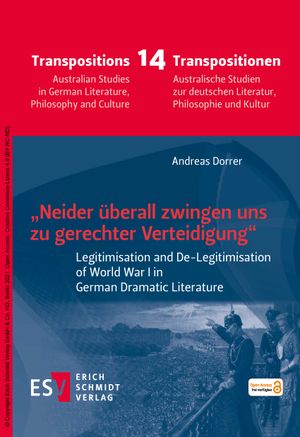

„Neider überall zwingen uns zu gerechter Verteidigung“: Legitimisation and De-Legitimisation of World War I in German Dramatic Literature
This first monograph on WWI dramatic literature closes one of the last research desiderata of the German literature on the First World War. The author opens up a hitherto unknown corpus of texts and identifies the most important discourses represented in these WWI plays. Furthermore, he embeds the discourses in contemporary public debates and identifies them in more famous dramatic works of the Weimar Republic. This allows the analysis of the Heimkehrerdramen of Toller, Brecht, and Horváth to focus on the representation of contemporary narratives that have so far been overlooked and embeds these plays in the context in which they were created. Previously, this was only the case for Karl Kraus’s Die letzten Tage der Menschheit, which is also interpreted by the author in a newly established intertextual relationship with early WWI dramas. The approach this book takes not only provides new insights into WWI dramatic literature from 1914 to the end of the Weimar Republic, but also new points of departure for research in a number of literary and cultural studies fields. Die Arbeit wurde von der Universität Jena und dem Weimarer Republik e.V. mit dem Friedrich-Ebert-Preis 2021 für die international beste Dissertation/Habilitation zur Weimarer Republik ausgezeichnet.
| Publication Language | English |
|---|---|
| Publication Access Type | Freemium |
| Publication Author | Andreas Dorrer |
| Publisher | Erich Schmidt Verlag |
| Publication Year | 2023 |
| Publication Type | eBooks |
| ISBN/ISSN | 9780000000000 |
| Publication Category | Open Access Books |
Kindly Register and Login to Shri Guru Nanak Dev Digital Library. Only Registered Users can Access the Content of Shri Guru Nanak Dev Digital Library.
You must be logged in to post a review.




Reviews
There are no reviews yet.