
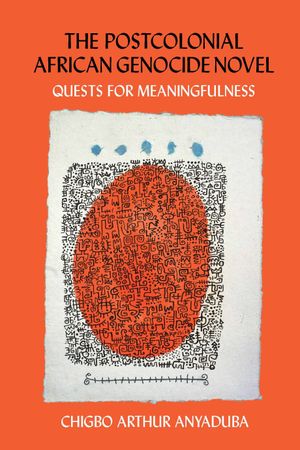


The Postcolonial African Genocide Novel: Quests for Meaningfulness
In The Postcolonial African Genocide Novel, Chigbo Anyaduba examines fictional responses to mass atrocities occurring in postcolonial Africa. Through a comparative reading of novels responding to the genocides of the Igbo in Nigeria (1966-1970) and the Tutsi in Rwanda (1990-1994), the book underscores the ways that literary encounters with genocides in Africa’s postcolonies have attempted to reimagine the conditions giving rise to exterminatory forms of mass violence. The book concretizes and troubles one of the apparent truisms of genocide studies, especially in the context of imaginative literature: that the reality of genocide more often than not resists meaningfulness. Particularly given the centrality of this truism to artistic responses to the Holocaust and to genocides more generally, Anyaduba tracks the astonishing range of meanings drawn by writers at a series of (temporal, spatial, historical, cultural and other) removes from the realities of genocide in Africa’s postcolonies, a set of meanings that are often highly‐specific and irreducible to maxims or foundational cases. The book shows that in the artistic projects to construct meanings against genocide’s nihilism writers of African genocides deploy tropes that while significantly oriented to African concerns are equally shaped by the representational conventions and practices associated with the legacies of the Holocaust.
| Publication Language | English |
|---|---|
| Publication Access Type | Freemium |
| Publication Author | Chigbo Arthur Anyaduba |
| Publisher | Liverpool University Press |
| Publication Year | 2023 |
| Publication Type | eBooks |
| ISBN/ISSN | 9780000000000 |
| Publication Category | Open Access Books |
Kindly Register and Login to Shri Guru Nanak Dev Digital Library. Only Registered Users can Access the Content of Shri Guru Nanak Dev Digital Library.
You must be logged in to post a review.




Reviews
There are no reviews yet.